Next week, I’ll be attending the 6th annual New Jersey GAFE summit. In addition to facilitating a few workshops, I’m also very honoured to have been invited to deliver the opening keynote at the event. My presentation, titled Developing critical literacies: What students need to know in a “fake news†world, addresses what I see as one of the key challenges facing educators today: preparing students to survive and thrive in our post-truth reality.
In anticipation of this event, I’ve compiled a small collection of key readings, viewings, and other resources on the Padlet found below.
I’d love for you to take some time to explore the information collected on the Padlet and then to think about how you might start to address the issue of fake news in your own school context. Then, please take a few moments to respond, by commenting on this post OR by submitting your own video response to the Flipgrid below. Even if you won’t be attending the New Jersey summit, I’d still love to hear your thoughts on this important issue in education!
This post was co-written with Katia Hildebrandt and also appears on her blog.
This week (June 5-11) we’ll be hosting a couple of events and activities related to digital citizenship as part of a series of DigCiz conversations. Specifically, we’d like to deepen the discussion around digital citizenship by asking how we might move from a model of personal responsibility (staying safe online) to one that takes up issues of equity, justice, and other uncomfortable concepts. That is, we want to think about what it might look like to think about digital citizenship in a way that more closely resembles the way we often think about citizenship in face-to-face contexts, where the idea of being a citizen extends beyond our rights and also includes our responsibility to be active and contributing members of our communities. Of course, that’s not to say that face-to-face citizenship is by default more active, but we would argue that we tend to place more emphasis on active citizenship in those settings than we do when we discuss it in its digital iteration.
So…in order to kick things off this week, we wrote this short post to provide a bit more background on the area we’ll be tackling.
Digital Citizenship 1.0: Cybersafety
The idea of digital citizenship is clearly influenced by the idea of “Cybersafety,†which was the predominant framework for thinking about online behaviours and interactions for many years (and still is in many places). This model is focused heavily on what not to do, and it relies on scare-tactics that are designed to instill a fear of online dangers in young people. This video, titled “Everyone knows Sarah,†is a good example of a cybersafety approach to online interactions:
The cybersafety approach is problematic for a number of reasons. We won’t go into them in depth here, but they basically boil down to the fact that students aren’t likely to see PSAs like this one and then decide to go off the grid; the digital world is inseparable from face-to-face contexts, especially for today’s young people who were born into this hyper-connected era. So this is where digital citizenship comes in: instead of scaring kids offline or telling them what not to do, we should support them in doing good, productive, and meaningful things online.
From Cybersafety to Digital Citizenship
Luckily, in many spheres, we have seen a shift away from cybersafety (and towards digital citizenship) in the last several years, and this shift has slowly found its way into education. In 2015, we were hired by our province’s Ministry of Education to create a planning document to help schools and districts with the integration of the digital citizenship curriculum. The resulting guide, Digital Citizenship Education in Saskatchewan Schools, can be found here. In the guide, we noted:
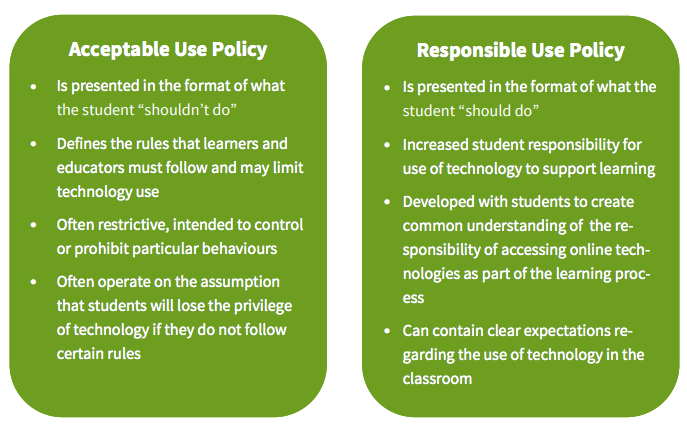
In the Digital Citizenship Guide, we also underlined the importance of moving from a fear- and avoidance-based model to one that emphasizes the actions that a responsible digital citizen should take. For instance, we suggested that schools move away from “acceptable use†policies (which take up the cybersafety model) and work to adopt “responsible use†policies:
Moving Beyond Personal Responsibility
While the move from cybersafety to digital citizenship has helped us to shift the focus away from what not to do online, there is still a tendency to focus digital citizenship instruction on individual habits and behaviours. Students are taught to use secure passwords, to find a healthy balance between screen time and offline time, to safeguard their digital identity. And while all of these skills are important pieces of being a good digital citizen, they revolve around protecting oneself, not helping others or contributing to the wider community.
So we’d like to offer a different model for approaching the idea of citizenship, one that moves beyond the individual. To do this, we have found it helpful to think about citizenship using Joel Westheimer’s framework. Westheimer distinguishes between three kinds of citizens: the personally responsible citizen, the participatory citizen, and the justice oriented citizen. The table below helps to define each type.
Table taken from Westheimer’s 2004 article, linked above.
Using this model, we would argue that much of the existing dialogue around digital citizenship is still heavily focused on the personally responsibility model. Again, this is an important facet of citizenship – we need to be personally responsible citizens as a basis for the other types. But this model does not go far enough. Just as we would argue that we need participatory and justice-oriented citizens in face-to-face contexts, we need these citizens in online spaces as well.
So here’s our challenge this week: Is there a need to move beyond personal responsibility models of digital citizenship? And if so, how can we reframe the conversation around digital citizenship to aim towards the latter two kinds of citizen? How might we rethink digital citizenship in order to encourage more active (digital) citizenship and to begin deconstructing the justice and equity issues that continue to negatively affect those in online spaces, particularly those who are already marginalized in face-to-face contexts? And what are the implications of undertaking this shift when it comes to our individual personal and professional contexts, especially when it comes to modelling online behaviours and building (digital) identities/communities with our students?
These are big questions, and we certainly don’t have the answers yet – so we’d love to hear from you! Please consider commenting/responding in your own post, or come join us as we unpack these complex topics during the events listed below.
This week’s events:
On Tuesday, June 6 at 3 pm EDT, we will be hosting a webinar to discuss this week’s topic. If you are interested in being a panelist, please email us at alecandkatia@gmail.com – we’d love to have you join us! The Webinar will take place via Zoom.Us – to join as an attendee, just click this link.
On Wednesday, June 7 at 8 pm EDT, we will be moderating a Twitter chat with a number of questions related to this week’s topic. To join, please connect with us on Twitter (@courosa and @kbhildebrandt) and follow the #DigCiz hashtag.
Hey everyone – I’m really hoping that you can support the following with your direct contribution or by sharing this far and wide.
Back in January of 2013, I initiated a massive open online course about edtech called #etmooc. It was an amazing experience for me, and perhaps most significantly, it introduced to me to a group of amazing, passionate individuals who have continued to learn and connect since the early days of the course.
These individuals have not only been great supporters of open and networked learning, they are also incredibly caring individuals who have demonstrated immense charity and kind regard for others.
As many of you may remember, the day after the last #etmooc session, my father Mario passed away unexpectedly. #etmooc participants and so many others in my network were there for me to provide their sincere condolences and support in my greatest time of need. I know that we often see the shallowness of social media connections, but I am fortunate to have experienced deep caring and friendship in these spaces.
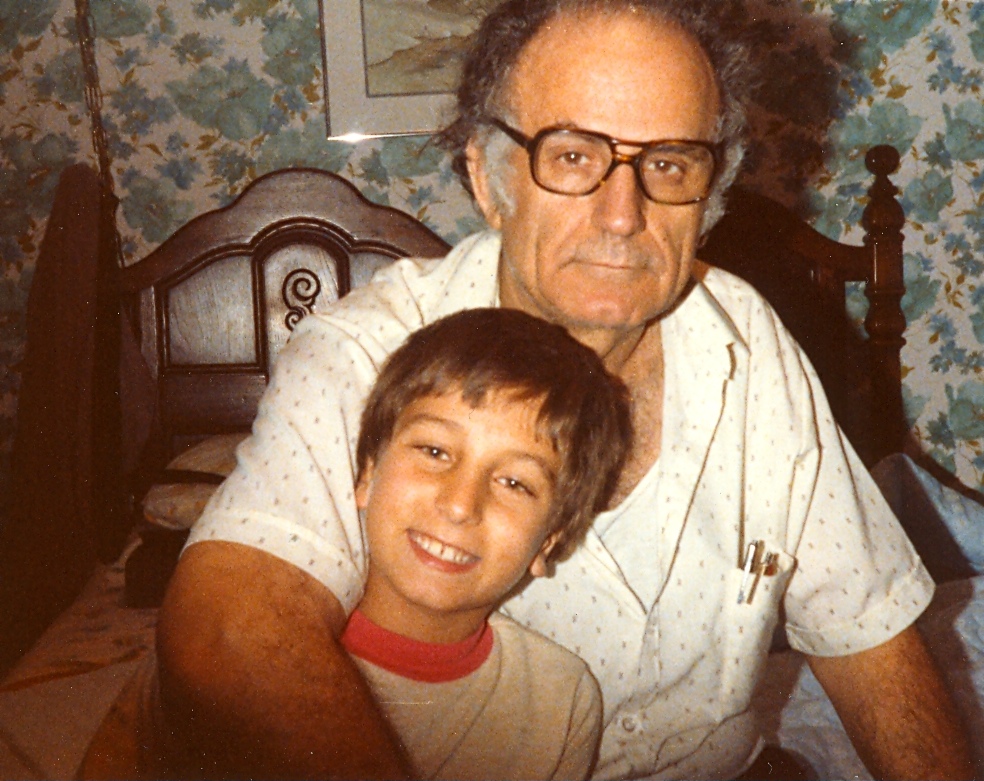
About a year ago, the group of #etmooc alumni surprised me with an incredible gift. They initiated a bursary at the University of Regina (my place of employment) in memory of my father. Befitting the fact that my parents immigrated to Canada in the 1950’s, the Mario Couros Bursary has been set up specifically to support the post-secondary education of a new Canadian who is looking to enter the Faculty of Education and become a teacher!
#etmooc has been raising money all year but they are still short of the goal of $25,000 Canadian dollars. So, to boost efforts, #etmooc individuals have taken the incredible additional step of setting up an online auction to raise funds for the additional amount needed to fully fund the bursary.
So what am I asking you to do here? If you are interested in the auction items, please consider going to http://tiny.cc/mariocouros and scroll down the page to bid on various items that have been donated by #etmooc participants. If you’re not interested in any of the items, you can also donate directly to the bursary through Erin Werner at the University of Regina, via phone at 306-585-5432, or via email at erin.werner@uregina.ca
Or, if you are not in the place to bid or donate, please consider sharing this post. I’m really hoping that we can fully fund the bursary.
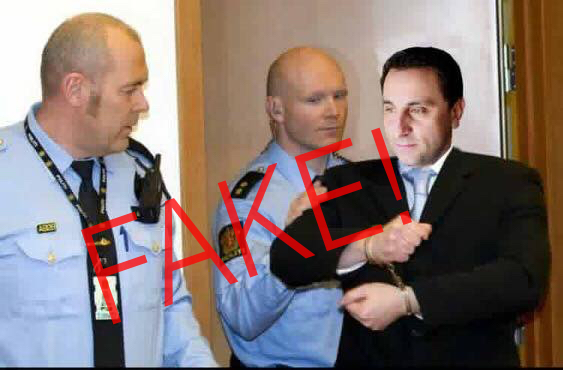
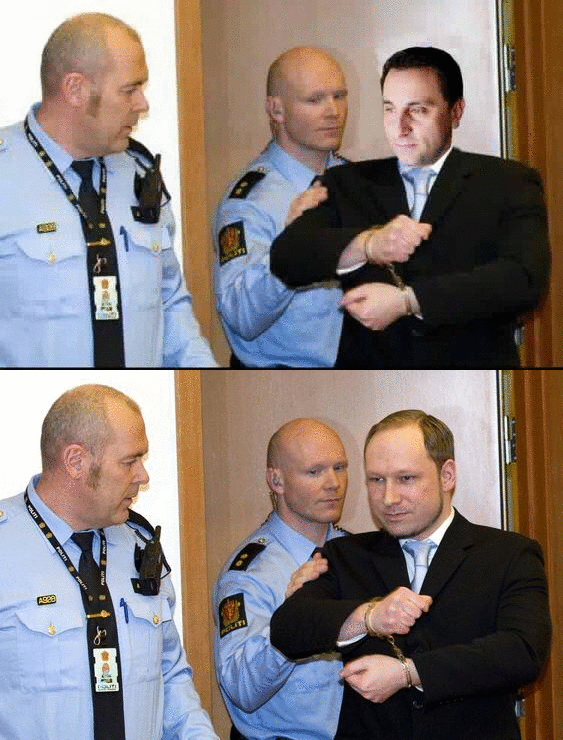
This morning, I received a photo (found below – I added the watermark) from a catfishing victim. She received it from a scammer who had used many of my personal and professional photos to form an online, intimate relationship with her for the purpose of defrauding her out of money. The victim finally clued into the scam after already sending him thousands of dollars. While it may seem ridiculous to fall for such a scam, I receive hundreds of similar reports every year, and if you know of my ongoing saga, you will understand that I have tried my best to bring the problem to the attention of Facebook, Google, elected officials, law enforcement, etc. None of these organizations or agencies seem to be willing or able to do anything about this problem, and thus I feel the responsibility of teaching about such Internet scams must continue to be taken up by educators in K-12 and post-secondary institutions.
Over the years, I have seen teachers make great use of interesting “fake sites” designed to help students develop information literacies/skills. Some of these include DHMO.org, Save the Endangered Pacific Northwest Tree Octopus, Feline reactions to bearded men, and DehydratedWater.com. And while these are still great resources that can be used with some success, given the abundance of fake news and internet scams that inundate our digital society, there are plenty of opportunities to use fresh and authentic examples in class.
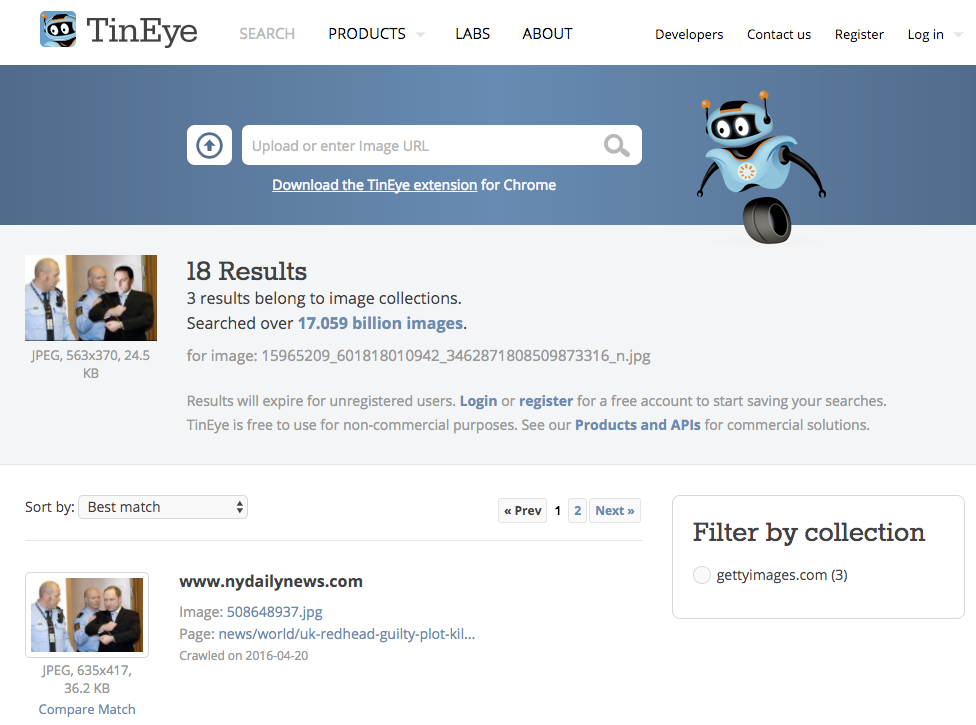
For instance, using the example of the photo above, students could employ some very basic info/digital literacy skills to identify the picture as a fake (i.e. photoshopped) picture through a reverse image search. In this Youtube video, I’ve previously demonstrated how to use Google Images to run a reverse image search, but I also wanted to highlight TinEye as an alternative tool for this task. To try out TinEye for this purpose, I would suggest that you download the above photo to your computer (ctrl-click+save or drag+drop), visit the TinEye site, and then upload the image to TinEye (there is also a TinEye Chrome extension available that makes the process a little quicker). In the case of the photo above, using TinEye produces the following results:
Exploring the resulting links, you will quickly discover that the original image shows Anders Breivik, who killed 77 people in Norway in a terror attack in 2011. Further investigation also reveals many additional photos of Breivik in custody, making it clear which version of the image is the photoshopped one (if the tiny size of my head compared to my body wasn’t already enough proof).
So there you have a component of a very basic information/digital literacy lesson that you could use in the classroom. However, I’d like to stress that these important tools and/or processes will likely not become first-nature to our students unless we help our students develop the disposition to approach the world with a critical eye. Recent studies have shown that young people are not, on the whole, very good at detecting fake news – and the stories that emerged regarding fake news about the U.S. presidential election being written by teens in Macedonia have made it clear that adults are equally vulnerable. There is little doubt that information/digital literacy will become more and more important in the years to come.
I’d love to hear from you. What strategies are you using in your classroom to help students become critical consumers and creators of information and media?Â
Catfishing schemes, or romance scams, continue to plague social networking services. In fact, the issue has become so common that there’s a good chance that one of your recent “friend†requests actually came from a scammer versus someone who is actually interesting in pursuing a genuine friendship. Unfortunately, social networks on the whole seem content to turn a blind eye on the problem, despite the fact that people lose thousands of dollars to these types of scams every day. So, due to this alarming issue and utter lack of response from social networking sites, we’ve compiled a few tips, techniques and questions to ask yourself when evaluating an online profile. We hope that this information might prove be useful for both personal use and as an instructional tool.
Step 1: Assess the authenticity of the profile picture
This is really the easiest place to start. Drop the picture into Google’s reverse image search to see where else the image appears. TinEye, a dedicated reverse-image search engine, is also a great tool that can be used for to perform this search. If the picture is associated with many different names or profiles, it’s likely that you’re dealing with a scam account.
Step 2: Critique the bio
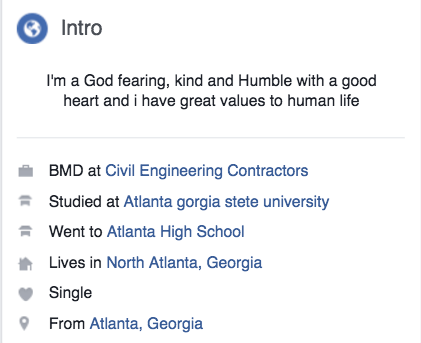
Catfishing accounts often use similar biographical components. Some red flags include:
A relationship status of “widowed†or “divorced†(obviously not all widowed or divorced people are catfishers, but this status in combination with other red flags might be an indication of a fake account)
A job that is of exceptional status and that may require a great deal of travel and/or periods without communication (e.g., military, engineer, oil worker, self-employed, shipping), making it easy for the scammer to make excuses for being absent, unavailable, or out of the country.
The name on the account can also be a clue about the legitimacy of the account:
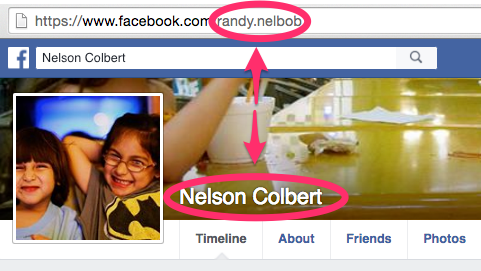
Many catfishers seem to pull from a list of popular names. If you search for the profile name on Facebook and lots of other profiles with the same name and similar occupations pop up, you may want to look more closely. At the time of writing, numerous “Nelson Colbert†profiles appear on Facebook and all seem to be fake profiles made up similar components discussed so far (e.g., stolen profile photo, suspect occupation, etc.).
Check to make sure that the name on the profile matches the name in the URL. Otherwise, it might be a sign that the scammer has had to change their profile name when a victim found them out.
Google the profile name. Most people have at least some sort of digital footprint these days. Can you find the person? Does what you find match up with what they are telling you?
Step 4: Investigate the profile page
Some other elements of the profile to watch out for include:
Number of friends: Does the person have few friends? Do their friends interact authentically with them on their page, or do you only see the same people commenting/liking over and over again?
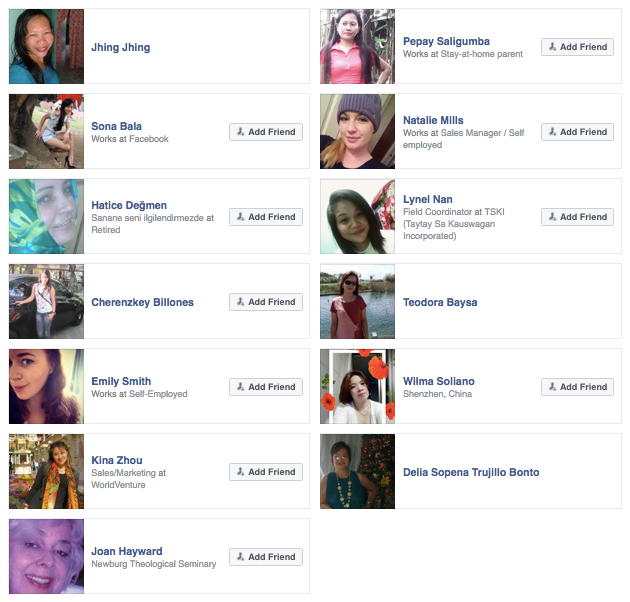
Types of friends: Often, if you are able to see the scammer’s friend list, it will consist overwhelmingly of people of the opposite gender (the target victims), as in this screenshot of a male scammer’s friend list:
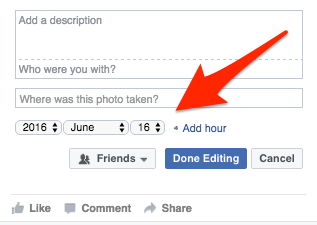
Age of the profile: Is the profile brand new, or is there a history of photo uploads, status updates, posts from others, etc? Also, note that profile posts can be backdated and locations can be faked (as seen in the image below) to make a profile seem like it has a longer history than it actually does. However, the year that the (Facebook) profile was created can’t be faked.
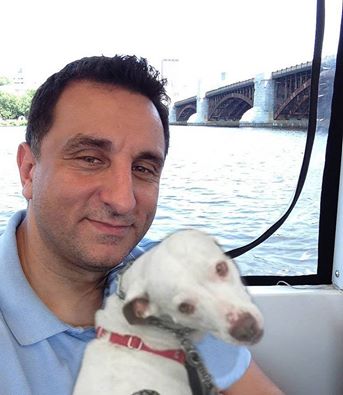
Photos: Does the profile have only a few photos, or are there a variety of photos, including photos with others (watch out for pictures with children, as this can be part of the scam)? Do the photos look photoshopped (see “ghost dog†example below)?
Mutual friends: Do you have any mutual friends? Note that having a small number of mutual friends isn’t necessarily a sign of legitimacy: scammers will sometimes friend a victim’s friends to make themselves seem more legit. If you have only a small number of mutual friends, it’s a good idea to contact those friends to see if they actually know the person. In many cases, your friend may have accepted the fake profile, due to less discerning personal protocols regarding “friending†or simply in error.
Language/grammar: Many scammers do not speak English as a first language. If you notice many spelling or grammar mistakes even though the person claims to be from an English-speaking country, proceed with caution.
Religious affiliation: Scammers will also often pose as devoutly religious individuals and sometimes use scripture or religious language to appear more trustworthy or to manipulate their victims through shared belief-systems. In fact, religion-specific dating sites such as Christian Mingle, JDate, or Shaadi are often used by scammers.
Step 5: Watch for tell-tale behaviours
Scammers often follow predictable patterns of behaviour, and there are some common red flags:
Use of a private messaging platform: A scammer will often quickly try to move the interactions over to email, SMS, or a different instant messaging platform. This is done so that if the original profile is identified as a fake account and removed by the social network, the scammer will not lose direct contact with their potential victim.
Rushing towards commitment: Scammers will try to move online relationships forward very quickly. It’s not uncommon for a catfisher to bring up marriage or to profess their love after only a few days or interactions; this helps to build a great sense of attachment and obligation, making victims more likely to agree to help the scammer later on.
Refusal to use video communication: Catfishers will often refuse to use anything but text or voice-based communication and will give excuses about poor connections to avoid having to Skype.
Repeated excuses to avoid meeting face to face: Catfishers will often make plans to meet up with their victims, but these plans will always fall through at the last minute for one reason or another.
Requests for compromising photos/videos: Often, scammers will request nude images or ask victims to participate in video chats of a sexual nature. These images or videos can then later be used to blackmail the victim, for instance, by threatening to send the files to the victim’s entire contact list or employer.
Emergencies: Once the catfisher has hooked their victim, they will likely be involved in some type of “emergency†situation. This might be an illness, loss of job, or the need to leave a location suddenly. In many cases, the scammer’s “children†may be involved.
Requests for money: This is obviously the top indication that you are dealing with a scammer. The request can take a variety of forms; two common techniques include advanced-fee fraud and requests for a money transfer through a company like Moneygram or Western Union (to make the money difficult to trace). Often, the victim will be told to send the money to someone other than the scammer (since the scammer is using a fake name).
Step 6: Ask for confirmation of identification
If you still aren’t completely sure whether or not you are dealing with a scammer, you can always ask for some form of confirmation.
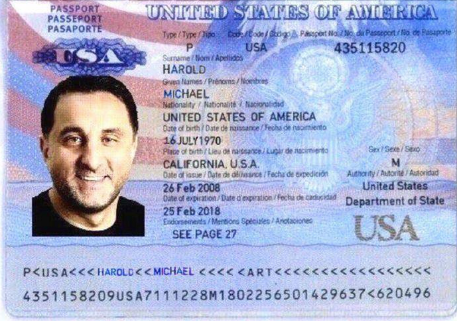
Passport: Often scammers will provide a photoshopped passport as proof of identity (as in the image below). If the passport seems questionable, you can find images of real passports from various countries and compare them. You can also check out the passport photo guidelines for various countries (for instance, here are the US guidelines), which can help you determine if the photo meets the size/shape requirements.
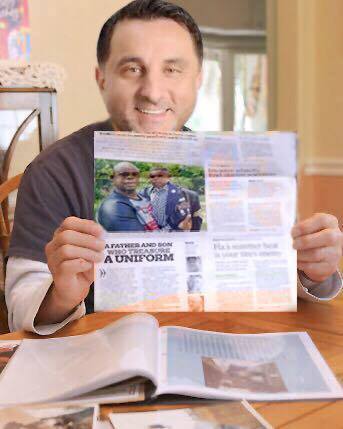
Real-time photo or video: To verify identity, you can ask the individual to provide a real-time photo (with a newspaper with that day’s date, or holding up a certain number of fingers) or to perform certain actions while on video (raise one hand, clap hands, etc.). As well, if the scammer does provide a photo, be sure to check for signs of photoshopping, like in this picture below where the head has been (poorly) photoshopped onto the body and thus seems inordinately large.
At this point, we also can’t stress enough the need to use your common sense. If a profile just seems too good to be true, it unfortunately probably is (just like you don’t really have a secret relative who is the king of an African country and wants to share his wealth with you).
Step 7: Block, report, and warn others
Once you have determined that you are communicating with a scammer profile, there are a few steps you should take:
Report: Most social networking or dating sites have some sort of reporting tool. Often, reporting a profile will lead to it being taken down, preventing future scams on that account. As well, many victims report fake profiles to sites like Romance Scam or to Facebook groups set up to share information on scammers.
Block: Once you have reported the profile, you should unfriend and block the user. You may believe that the damage is already done, but if you do not unfriend and block the scammer, they will still have access to your photos, account info, and friends list. As well, people may see that you are friends with the scammer and take this as a sign that they can safely friend the account themselves.
Warn others: Another good step is to warn others in your circle of friends, especially if you notice that the scammer is attempting to connect with other members of your contact list.
Be vocal: Although there have been many attempts to improve policies at social networking services (we’re looking at you, Facebook), ultimately it will likely take a critical mass of complaints, media coverage, and awareness in order to achieve real change. So make you voice heard!
Other things to look out for:
Scammer “familiesâ€: In some cases, scammers will create an elaborate network of friends and family in order to bring legitimacy to the scammer profile. For instance, the fake Alex Gallart’s circle of contacts included his mother, friend, and daughter (of these, only the mother’s profile, Maria Gallart, is still up). In this case, scammers were actually using real photos of Alec’s family members to build the fake family.
Twinned accounts: One technique we’ve seen more of recently is when scammers create accounts that are essentially doubles of existing accounts. For instance, see these two photos:
Scammers will use these profiles to connect with the real person’s friends and family, who simply think they are (re)connecting with the victim. Then, the scammer can use a variation on the “grandparent scamâ€in order to ask friends and family to send money to deal with an emergency.
Despite the fact that I’ve already had to submit my government-issued ID to Facebook in each previous case.
Despite the fact that my account is nearly a decade old and linked to 2000+ Facebook friends.
Despite the fact that I’ve had countless media interviews about the problem.
If it can happen to me, it could certainly happen to you.
I’m starting to feel like a broken record, but I really need your help. Please share so that we can get Facebook’s attention. The reporting system is badly flawed, and as I’ve written previously, Facebook really needs to get it fixed.
Facebook often fails to take down fraudulent profiles: While I have successfully had Facebook take down hundreds of fake profiles (I find several new ones each day), there are certain profiles that it simply does not take down. For instance, I’ve been trying to get Facebook to take down the account of “Trofimov Sergei” (a user who is clearly using a profile photo of me and my son) for over a year now. Yet, no matter how many times I report the account, the profile remains. More disturbing is the fact that if you search for “Trofimov Sergei” on Facebook, you will see dozens of fake accounts by the same name using stolen photos of other men. Most of the deception is done in private communication with the (potential) victims, but every once in a while, you will find a public post where the fraudsters are asking for money for a feigned illness. Luckily, there are many people (often former victims) who do uncover and share their knowledge of these fraudulent accounts in order to contain some of the damage.
Scammers may use photos of your children as their profile photo: After hundreds of reports, Facebook still refuses to take down the account of “Nelson Colbert,” a scammer who is using photos of my children as a profile photo. When you report an impersonation in Facebook’s current reporting tool, you ultimately have to choose one of the following: A) “This timeline is pretending to be me or someone that I know”, or B) “This timeline is using a fake name.” I have been completely unsuccessful when using Option B, and I have had only limited success with Option A: when you choose this option, you are asked to identify the user who is being impersonated, but when I identify myself, Facebook quickly rejects the report as it is clear that I am not the person in the profile photo. I have attempted to use Facebook’s “Report An Underage Child” tool (which is only available in Canada after you logout, apparently), but this has also been completely unsuccessful. The most unnerving part of this particular profile is that I receive more reports about it from victims than I do about any other. In fact, there are literally dozens of pages of search results that relate to “Nelson Colbert” and this scammer’s involvement in fraudulent activities. Yet, it appears that Facebook has made this account untouchable. I suspect that the scammer behind it may have created falsified documentation to get the account validated internally.
Scammers may use your elderly mother’s photo as their profile picture: These criminals often create sophisticated networks of friends and family in their schemes. For instance, the scammers created a fake profile using my mother’s photos and named her Maria Gallart. I cannot report this profile directly to Facebook; instead I am only able to report it to my mother to deal with it. I did so, and as you would imagine, the distress, anxiety, and uncertainty that this caused my nearly 80-year-old mother was not something that she needed nor something that she necessarily knew how to deal with. And even with my assistance, reporting the fraudulent account from my mother’s account (many times) has not led to the account being taken down.
Facebook doesn’t always believe the “real” person in cases of identity fraud: Facebook has taken down my account twice because a scammer reported me as being the fake Alec Couros. In both cases, I had to submit my passport to Facebook via email for verification (which is incredibly problematic for security reasons). I am unsure of why I had to do this twice, and I am puzzled as to why my account wasn’t verified either time (even though I have applied for verified status). Facebook’s proposed system will have to rely on verifying an account using a secure, consistent, and foolproof system if it is to be successful. To date, the company has failed miserably in this respect.
Facebook’s proposed system could give an advantage to the criminals: Fraudsters have often used photos of me that I have never previously used on Facebook. Based on the incomplete details provided so far about this new alert system, one might assume that if I were to use any of my personal photos after a scammer had done so, I would be the one flagged as an impersonator. Thus, the criminal might easily be regarded as having the authentic profile, which sounds like really bad news.
The Mashable article shared at the beginning of this post states that Facebook is rolling out these features as the company attempts to push its presence into regions of the world where “[impersonation] may have certain cultural or social ramifications” and “as part of ongoing efforts to make women around the world feel more safe using Facebook.” If that is the goal, Facebook’s proposed technology won’t help, and it may very well make things worse for women (or anyone) using the site. Already, Facebook is plagued with identity thieves who adversely affect the safety, comfort, and freedom of many of its users, and the problem will only continue to grow with these types of half-baked efforts. You may not be affected now, but unless Facebook does something to fully address this issue, you almost certainly will be.
I’ve written and spoken extensively about my problems with romance scammers, criminals who have used my photos (and the photos of many others) to create fake profiles and trick victims into sending them significant amounts of money. In my research, I’ve learned that many potential victims ask for a video chat with scammers as a way for them to prove their identities. In fact, participating in a video chat and then asking supposed suitors to perform particular actions on request (e.g., hold up two fingers on your left hand) is often touted on anti-scammer sites as a way to ensure that the person that you are talking to is in fact who they say they are and not a scammer who may be using recorded video as their video source (a common and frightening possibility).
Researchers from Stanford University recently released a project that works to “animate the facial expressions of the target video by a source actor and re-renders the manipulated output video in a photo-realistic fashion.” The results are incredible, but the implications for identity theft are incredibly frightening, in effect allowing scammers to become puppet masters who manipulate the faces and bodies of their fake profile avatars. Takes the idea of “authentic identity” to a whole new level, doesn’t it?
For a number of years, I’ve enjoyed using Reddit as a source for my daily reading. Reddit, often known as “the front page of the Internet,” is often where one can find stories and trends before they go viral in the mainstream. As well, because of the networking and conversational properties of the spaces, I’ve often mused about the potential of Reddit as a space where educational conversations might be hosted and shared. There are several education-related subreddits (specifically-themed topics or communities) such as r/education and r/edtech, but these spaces tend to be a bit stagnant.
Just recently, my friend @j0hnburns (and colleagues) took on the idea of developing a new subreddit at r/NextSpace with the goal of creating a space where deeper conversations around edtech related topics could be hosted and shared. He’s written about the launch and has included the overall rationale, how to get to started with Reddit, and how to contribute to r/NextSpace.
To help with this launch, I’ve agreed to do an AMA (Ask Me Anything) starting on Monday March 14th, 8pm EST (or see your time conversion here). To participate, check out this AMA thread, ask questions (you can post them early if you like), upvote or downvote the questions or comments of others, and I will do my best to respond to whatever gets asked. I know I’m nowhere near as big of a draw as those who have led some of the most popular AMAs, but hey, I’d like to help in any way to get this started. Plus, I think I have a lot to share regarding my thoughts on edtech, digital citizenship, digital identity, or other related topics. And of course, an AMA is about what you contribute as well!
So I hope that you will give Reddit and r/NextSpace a try, and hopefully I’ll hear from you at the AMA next week!
Yesterday, I received the following Facebook message:
I posted this to my Facebook wall when I received it, and it was interesting to hear from several people who felt they might have been fooled had they received the same message. After nearly a decade of becoming familiar with the tricks of these scammers, I question just about every angle. While this was the first time that I have received a message like this, the motive for the message seemed obvious to me. A photo of me that verifies the date would make it possible for a scammer to “prove” they were really me (rather than just using old photos). As well, if I had Googled the name of the sender (like my colleague Katia did), I might have wondered how this famous Nigerian business woman had the time to message me personally (and perhaps even why she cared about a mere 150K).
Today, I was contacted by another person on Facebook who had heard from her friends that a profile with her name, photos, and identifying information was trying to friend many of them. Several reported this to be suspicious so she immediately warned her friends with a status update. I asked her where the fake profile was and she found it for me. What we noticed was really sneaky (and horrible).
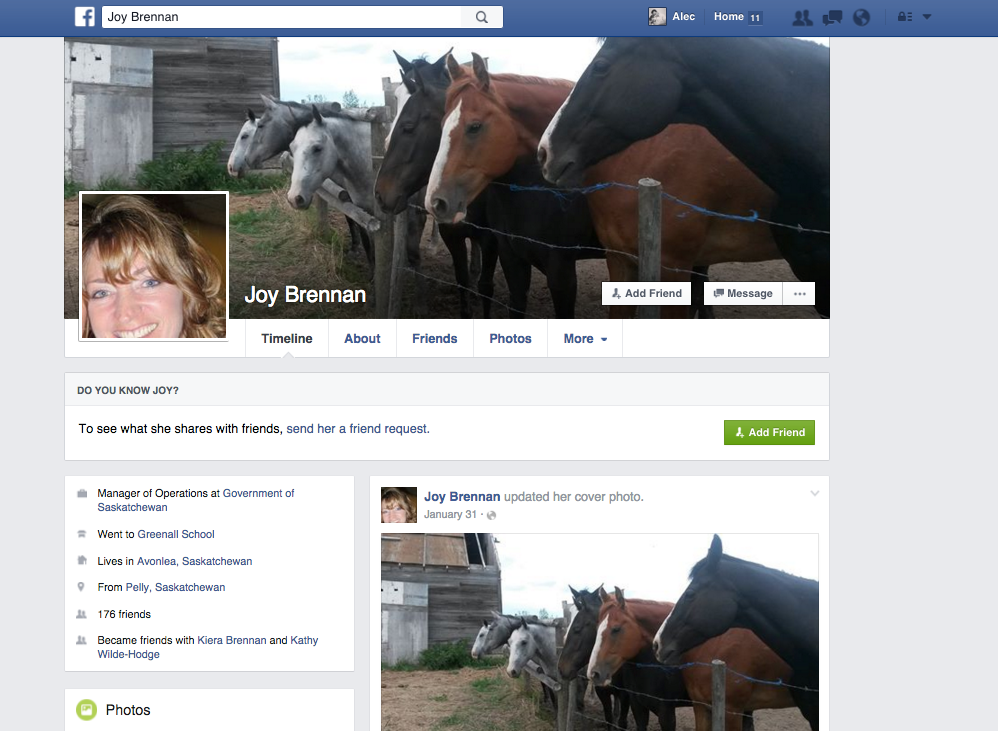
See below, the real person’s profile:
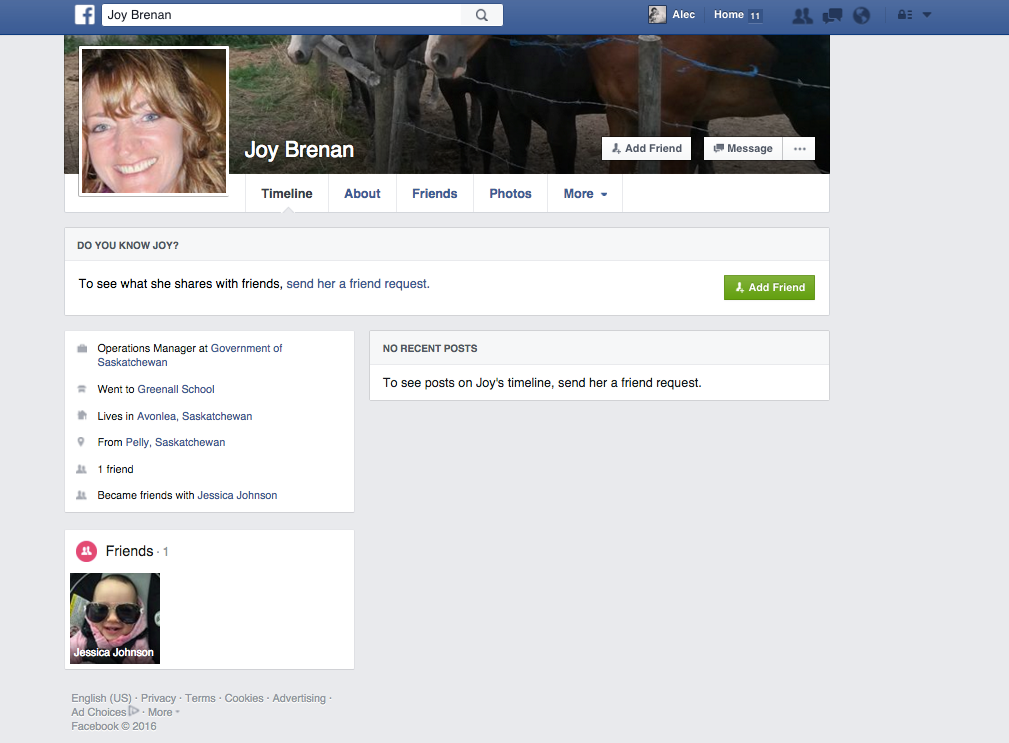
Now, look at the fake profile:
Do you see the important difference? The profile and header photos are the same in each. The friend count is certainly different. But the big thing is the spelling of the name. The authentic profile is “Joy Brennan” (two ‘n’s) and the fake profile photo is “Joy Brenan” (one ‘n’). The especially sneaky part is that if you were to try and search for fake Facebook profiles with your photos and name, this would make these much more difficult to find.
So why would the scammers do something like this? My guess is that they were hoping to perform a scam such as the common “email hijack,” where members of an existing friends/family network could eventually be tricked into sending money due to a contrived distress call (e.g., I was robbed while traveling, please wire me money).
So there you have it -Â a couple more scams to be concerned about. Oh, and Facebook still isn’t doing anything about these problems.
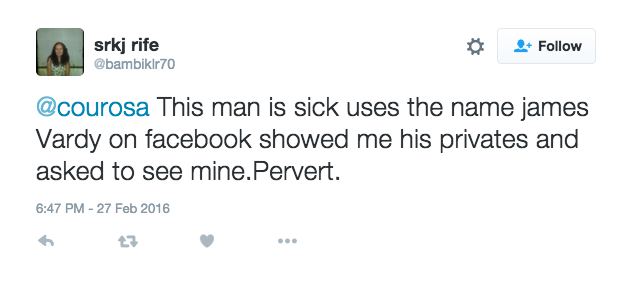
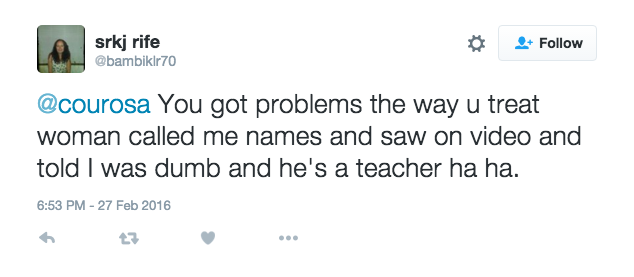
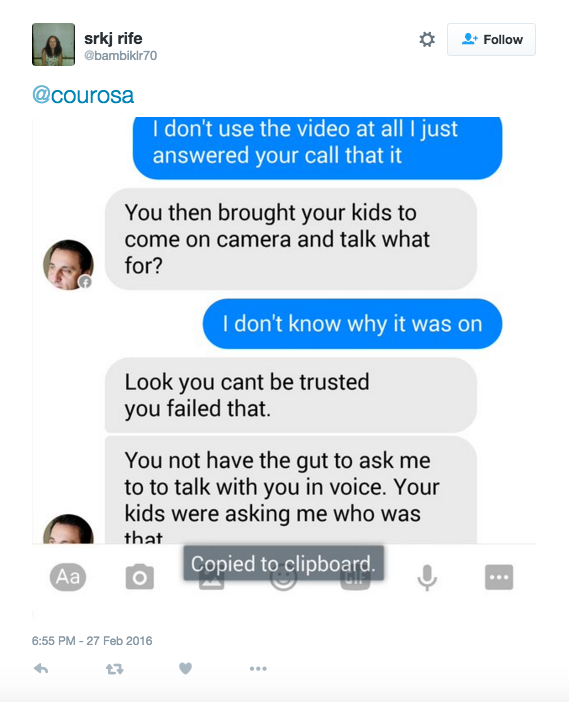
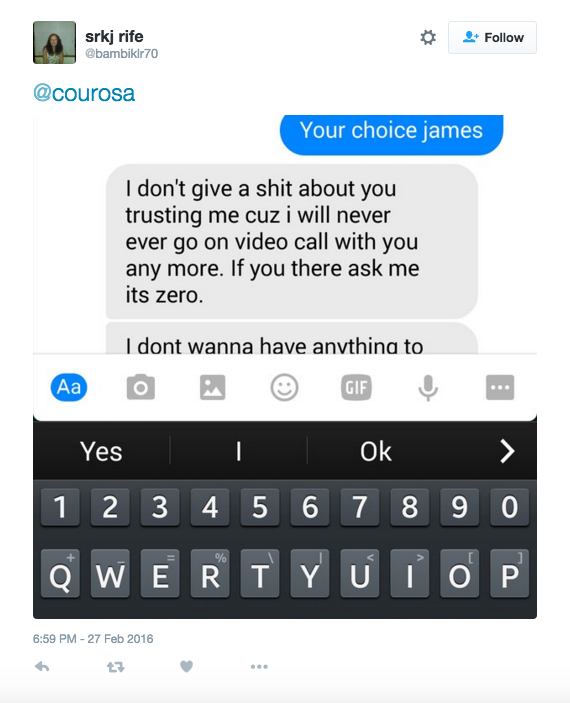
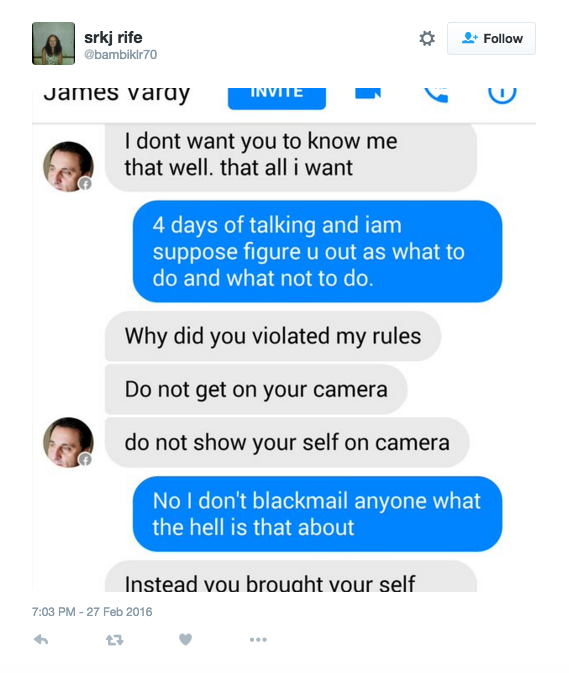
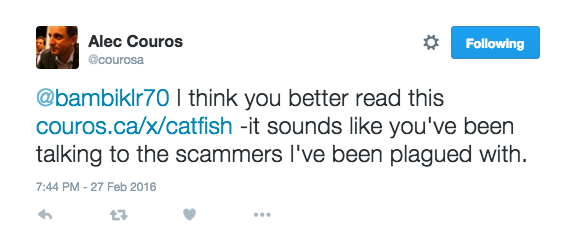
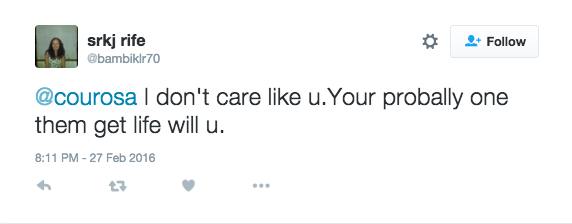
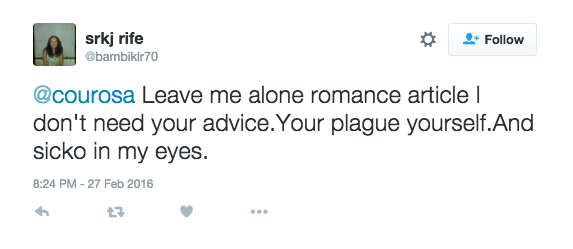
Landing in Regina tonight, I checked my phone to find the following tweets directed at me.
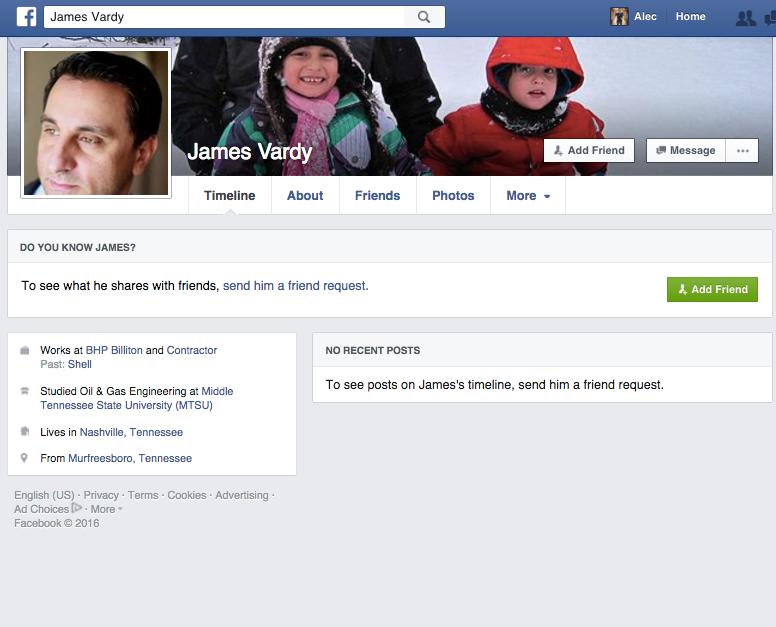
From what I was able to understand, it appears that this tweeter has been chatting with a person by the name of James Vardy who is using my photos (as seen in the screenshots). However, she believes that I’m the guy she is actually talking to and that I’m “sick” and a “pervert.” A quick search in Facebook brought up this fake profile that I have now reported. Below is a screenshot in case it actually gets taken down by Facebook (which is rarely ever the case).
James Vardy Fake FB Profile
It was difficult to make out exactly what happened between this tweeter and the scammer. It sounds like the scammer didn’t want to use video during chat, but this tweeter did and it broke his “rules.” The scammers obviously would much rather communicate via audio or text because video can give up their identity (unless they are exploiting the videos of those they impersonate such as in the manner that I describe in this clip). Even so, this fake video approach only works in small doses and scammers only use it to strengthen their deception and then continue on via text and voice.
You’ll also notice that the tweeter opens up with accusations that I was showing her my “privates.” Sigh. I’m not sure if this tweeter actually saw someone’s privates on her screen, but I know that this sort of explicit interaction is commonly sought out by scammers to provoke their victims to share the same. Once the scammers have captured explicit photos of their victims, the scammers can then blackmail victims for money or in rare cases, the victims can become scammers themselves.
Fun, hey? I didn’t bother replying after that. While her tweets are public, my replies only bring publicity to the situation and I assume that most people who read my tweets don’t actually know about my long-term catfishing predicament.
It’s honestly exhausting dealing with this. And, I’m not the only one who is having to do so. Check out Alan’s latest post on his efforts in trying to get Facebook to take down a scammer account that is using his photos. This overall situation is only going to get worse, and social networking services continue to look the other way.