I recently received the following message via email. I’ve omitted a small portion of the text to protect the privacy of the sender and have only corrected a few spelling errors to improve the overall readability of the passage.
I know you do not know me, but I had to share something with you. Â My name is [omitted]. I have been divorced for two and a half years. My focus has been on God and my three children. I finally decided to start dating again and some friends set me up on Christian Mingle, something that I would never do.
So to make a long story short, there I met you. You sent me an email telling me you were an engineer that travels all the time. You had two kids and your wife died giving birth to the last. The relationship we shared was long distance because we lived in different states so we talked on the phone, sent emails including pictures and also texting. We were so involved until we fell in love and l started loving your children as well.
And, we also discussed marriage. You were supposed to come visit me for the first time in October. I was so excited. We have been dating for 6 months. Of course I questioned your ID at first so I Googled you. You told me your name is Jeffrey Bartel on vk.com. There you were and I did not question a christian site.  All up until this day I have loved you with all my heart.
Today was the worst day of my life when my 17 yr old son comes to me and shows me a picture of you on Youtube as Alec. I died in that moment. I now realized that the person that I have been in love with has your face but is another person. The last time I felt such pain, my mother died of cancer.  Well, that is my story and I just wanted you to know that.
This is so hard for me. I actually have a picture of you in a frame in my office at work and at home on my night stand. I will be removing it tonight.
This is so incredibly sad and heartbreaking. This is a very honest account of a woman who has been victimized by individuals employing a “catfishing” scheme, a type of romance scam. Catfishing is when individuals or groups create false digital identities to lure victims into online, romantic relationships. While similar fraudulent activities have existed since the dawn of the Internet, social networking sites and dating services have simplified and scaled the mechanisms used by scammers. The term “catfish” comes from the 2010 film by the same name. In such cases, the romantic relationship is formed and maintained for the purpose of eventually defrauding the victim out of money or goods.
And, this isn’t the first time that someone has come forward to me about my photos being used in this way to deceive others. There have been at least a dozen incidents like this reported to me in the last five years. And, this Romance Scam thread reports a number of other incidents that were not forwarded to me directly. I presume that there are dozens of others that have occurred or are happening right now.
Shared below is the text from an email message that I received from a woman from Hungary this past June. Again, certain portions have been omitted to protect the privacy of the sender. This passage is more difficult to understand due to language differences, but I’ve left most of the message intact in order to fully communicate the writer’s intended message and sentiment.
Forgive my disturbing You with my letter – we don’t know each other. My name is [omitted], I live in Hungary.
Knowing your writings, videos and pictures I think you are, a valuable, balanced and shining happy man. And you can all these things pass other people,too – so they can it use for themselves in their life for their happiness. Your work make me follow you and, reach more successes in my life and working, too. And I have to make better my English – it isn’t perfect…
My last years wasn’t too happy and I feel I have to tell you:  live people who don’t know that they never will be happy while, they hurt their fellow. I think you met such a man…I write about this thing because, it is in connected through you. Lives a man/ or any number  live people who uses /user name/ your happenings of your life and your pictures in order to deceiving, lying, etc… They mixed, your stations of you life and changed and rewrote your autobiography as they so want get happiness for themselves. Maybe, some women who desire or loved would give love, and who aren’t careful – become their deluded. I was one of this kind of woman…
I already forgave them but I would like to save others from bad feelings, and they suffer damage – so I send you a link. I don’t know that, you have already seen, but I want to know you information. People who work with the internet and live in public – endanger all the time their honesty.
http://www.romancescam.com/forum/viewtopic.php?f=3&t=46277.
They emerged on the Facebook, too and they introduced as Evans Thompson – and promised me a happy connection..
I noticed in time that he was an impostor – but I didn’t hear about, you till now, the You life, I have not heard.
http://www.scamwarners.com/forum/viewtopic.php?f=13&p=134639.
I reported him – pressed charges -, and his profile have been deleted from that place. If you have enough time – it is worth to inquire with the supplying of the Google – picture’s searching – so you can see using your pictures and fame renown.  I am happy to find, the real you people. I’m sorry, that my pain is real. But I, be further wish you, a happy family, 3 dear kids, father you are. I believe that my failures weren’t in vain.
I think they, were necessaries for me to my developing and collecting knowledge is. I more special branch of science – for example by your teaching – I started learning..
Thanks for it you live, and you to listened, and I am glad, so. Our life is incalculable! – I think it is an exciting playing all the time! – Bye.
This case was very similar to the one I initially shared. Scammers used photos of me to create a false identity, and then lured and victimized this woman. What I found particularly interesting in this case was that the victim used the reverse Google Image search to verify the source of the images that were shared. Several others who came forward mentioned that they used this same tool, or the similar reverse image search tool Tin Eye, to identify the source of suspect images. The use of reverse image search in this way is fascinating as it is most typically employed as a copyright-related search tool. I believe that using this tool in this way, to assist in the authentication of someone’s online identity, is a valuable process that should be shared widely, include with school-aged children.
A message from another woman is found below. In this case, the message was originally written in Spanish. Thus, I initially thought that this might simply be inbox spam (I don’t get many Spanish email messages). But, I decided to run the message through Google Translate. Reading the very first sentence confirmed that this was the right thing to do.
Mr. Couros, maybe you do not speak Spanish, but you can use google translator to read this message. I found your information because there is a group of con artists elsewhere in the world, who swindles women like me with similar profile all, in my case appertain  pictures of him with his children, maybe you are already aware of this situation this but I want you to know still using her photos to scam people.
If you are interested in more information, you can ask whatever you want about what happened with me.
Of course, I was very interested to find out more about her situation, so I followed up for more information. This was her response:
Good Night Mr. Couros
Unfortunately if I was a victim of these people. Thank God I discovered things on time and I have nothing to regret I received an email on Facebook telling me a story and I was gradually entangled with romantic words and lies. They sent me pictures of you, but I eventually discovered that the only thing sought is money. I sent money on what seemed as absurd story. It was very painful, everything seemed so beautiful but the disappointment was very unpleasant.
Excuse me for saying so, but now I see your photos bring me so many different feelings for the person you loved is its image. Take care much, I imagine that there are several people that were victims.
While in this case, it seems that money was sent to the perpetrators, it does not appear that this was of most concern to the individual. In fact, in the majority of these cases it wasn’t the theft that seemed of greatest significance. Rather, the betrayal in most cases led to deep emotional hurt, often resulting in heartbreak. This is incredible to consider, but not surprising, as we’re seeing a great increase in the number of married couples who first met online. The Internet is a powerful place where humans can forge strong relationships. Unfortunately, it is apparent from these incidents that it can also be done under very deceitful and fraudulent circumstances.
So this is something that will certainly be on-going. I don’t imagine this sort of thing going away tomorrow. So, I wanted to share a few things that I feel I have learned from this experience. And, I hope that you can share your thoughts as well so that we can learn from this together. Here are a few of my initial ideas.
- Having a well-defined online identity is both the cause and cure of such scenarios. If I didn’t have anything online, this might not have happened. But, I know of very few people today who have are digitally non-existent. If someone can string a few stories together with the photos you have online, this could potentially happen to you. And, it was because of my strong digital identity that people were able to search, interpret the “real” me, and contact me with an increased level of confidence.
- Digital literacy is necessary for determining the validity of sources, including the integrity and authenticity of our relationships. I remember the great wisdom of Homer J. Simpson when he stated, “It takes two to lie. One to lie, and one to listen.” We should remember that the continuum of constructing our identities begins with authenticity and ends with complete fabrication. As both identity constructors (our own) and identity interpreters (of others), we must consider these dynamics.
- Internet scams, especially romance scams, are more prevalent than we think. I know that many of us joke when yet another deposed political rebel wants to bestow us with millions of dollars in relations to the popular Nigerian/419 scams or what are otherwise known as advance fee frauds. The RCMP report that, “Advance fee loans operating for a criminal purpose generate millions of dollars annually in Canada.” And, I know from the recent experience of trying to sell my mother’s car on Kijiji that one can be bombarded with scams that may seem to good to be true for some, but perfectly reasonable to others who are less savvy.
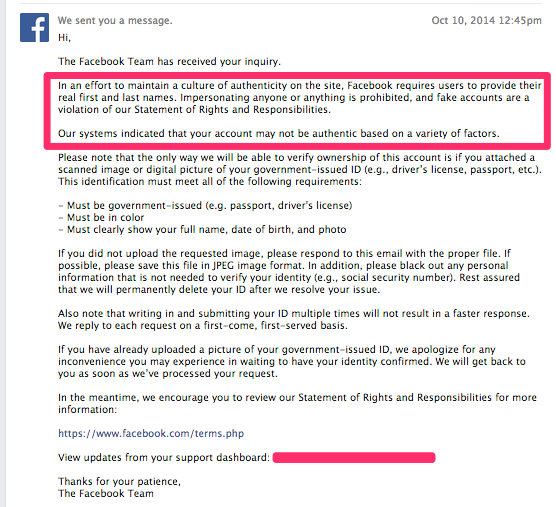
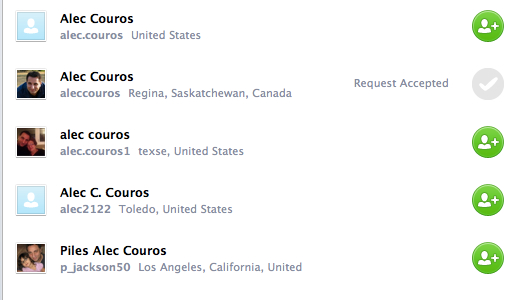
- We need better ways of authenticating and protecting our identities. For instance, there is someone on Facebook who is using my name and a slide from one of my presentations. People who have ‘friended’ this individual have messaged me (they searched for the “real” me) after this person has solicited money from them. Yet, even with this evidence, I can’t get the page taken down. Facebook reviews the reports I submit and they always come back rejected. The existing processes are clearly flawed at Facebook and I assume this is similar of many other services.
- There are many unscrupulous people out there willing to sacrifice your feelings for money. This is nothing new. But we can’t forget that there are amazing stories of selfless individuals all around us. We must not fear. Or hide. And we need to keep sharing all sides of our human experiences.
- This needs to be a topic in school as part of a required digital citizenship curriculum.
- People fall in love online. Those feelings of love may feel no different than what you and I feel for those we love. And when deception is involved, lost love hurts equally as bad.
So, what are your thoughts, experiences, and insights? I want us all to learn from this.